Are You Building a Brand… or Just Feeding the Process?
There’s a strange kind of exhaustion that hits modern creators.
Not the “I worked hard today” kind.
The heavier kind.
The kind where you spend 9 hours editing clips, resizing thumbnails, rewriting captions, fixing timelines, adjusting transitions, organizing folders, tweaking fonts… and somehow end the day feeling like nothing actually moved forward.
Your content isn’t growing faster.
Your business isn’t becoming simpler.
Your creativity feels drained.
But your task list? Completely full.
That’s the productivity illusion.
And it’s quietly becoming one of the biggest reasons creators burn out before they ever build real momentum.
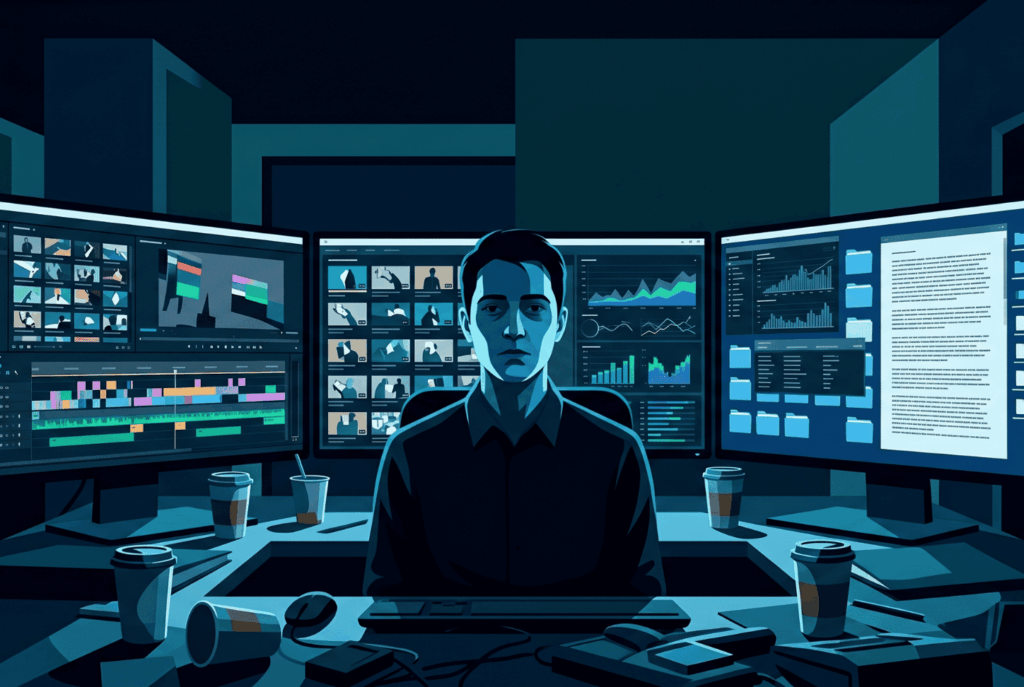
Especially now, in a world where content moves faster than ever, many people are confusing activity with progress.
They’re busy every day.
But they’re not building leverage.
And deep down, they know it.
The Internet Glorified “Grinding” for Too Long
For years, creators were taught the same formula:
- Work harder
- Edit longer
- Learn more software
- Post more content
- Stay up later
- Do everything manually
At first, this feels productive.
You’re constantly doing something.
Your brain gets rewarded by visible work:
exporting files, trimming clips, color grading videos, rewriting scripts, fixing audio levels.
It looks like momentum.
But often, it’s just maintenance disguised as ambition.
A lot of creators are spending their best creative energy on technical friction instead of actual storytelling.
And that’s where things start breaking.
Busy Creators Often Feel the Most Behind
This is the painful part nobody talks about.
The creators working the hardest are often the ones feeling the most stuck.
Why?
Because manual workflows create emotional fatigue without creating scalable progress.
You spend hours producing one piece of content…
Then wake up the next morning and start from zero again.
No systems.
No repeatability.
No compounding momentum.
Just another mountain of manual tasks waiting for you.
That cycle slowly destroys motivation.
And eventually, creators start asking themselves dangerous questions:
- “Why does this feel harder for me than everyone else?”
- “How are other people posting so consistently?”
- “Am I just not disciplined enough?”
- “Why do I work all day and still feel behind?”
The answer usually isn’t laziness.
It’s friction.
The Hidden Addiction to Feeling Productive
Here’s something uncomfortable:
Sometimes creators stay busy because busyness feels emotionally safer than growth.
Manual work gives immediate psychological rewards.
You can see yourself working.
You feel responsible.
Dedicated.
Committed.
But deep work, the kind that actually grows a business, often looks different.
Real growth usually comes from:
- Better systems
- Better leverage
- Better storytelling
- Better positioning
- Better distribution
- Better consistency
Not necessarily more editing hours.
But because those things are less visually dramatic, people underestimate them.
So instead, they stay trapped in “creator admin mode” forever.
The Creator Who Worked 12 Hours a Day
A few months ago, a small YouTube creator posted something brutally honest online.

He said he spent almost every evening editing videos after work.
Weekends too.
He was constantly learning new software tricks, transitions, cinematic effects, motion graphics, color correction techniques , all to make his content “look professional.”
But after nearly a year?
He had only uploaded 19 videos.
Nineteen.
Not because he lacked ideas.
Not because he lacked discipline.
Because perfectionism and manual workflows consumed all his energy.
Then something changed.
Instead of obsessing over technical production, he simplified everything.
He focused on:
- story structure
- emotional hooks
- publishing consistency
- simplified workflows
- AI-assisted production systems
And suddenly?
He started uploading 3–4 times faster.
His audience grew faster too.
Not because his videos became “perfect.”
Because he finally had momentum.
That’s the shift many creators are experiencing right now.
The Future of Content Creation Isn’t Faster Editing
It’s editing less.
That sounds controversial until you realize what’s happening across the creator economy.
The internet is moving toward leverage-based creativity.
Creators no longer want to spend months learning complicated editing systems just to produce decent content.
They want:
- smoother workflows
- cinematic-looking output
- scalable production
- long-form storytelling
- less technical struggle
- more creative freedom
That shift is everywhere right now. Even emerging AI-video platforms are positioning themselves around reducing friction and eliminating complicated editing processes entirely. Tools focused on cinematic long-form creation are attracting creators who want professional-looking content without spending years mastering editing software.
And honestly?
That desire makes complete sense.
Most people didn’t start creating content because they loved adjusting keyframes at 2 AM.
They started because they had ideas.
Stories.
Messages.
Vision.
But somewhere along the way, the process became heavier than the creativity itself.
Why Technical Struggle Feels So Draining
There’s a psychological reason manual content work becomes exhausting.
Every tiny technical decision drains cognitive energy.
Your brain constantly switches between:
- storytelling
- editing
- audio
- visuals
- formatting
- exporting
- troubleshooting
- platform optimization
That constant context-switching creates mental fatigue.
And over time, creativity becomes associated with stress instead of excitement.
This is why many creators secretly admire people who built smooth, automated workflows. The appeal is not laziness , it’s freedom. Many creators want to focus more on creation and less on technical struggle.
The emotional difference matters more than people realize.
A creator who enjoys the process will almost always outlast a creator who constantly fights the process.
The Rise of High-Leverage Creators
Look closely at fast-growing creators today.
Many of them are not necessarily the “best editors.”
They’re the best system builders.
They know how to:
- repurpose efficiently
- simplify production
- reduce creative friction
- automate repetitive tasks
- create repeatable formats
- publish consistently
That’s leverage.
And leverage changes everything.
Because once the process becomes lighter, your brain finally has space for the things audiences actually remember:
- emotion
- storytelling
- perspective
- insight
- personality
- clarity
Not transition packs.
Not overedited timelines.
Not cinematic lens flares.
The Dangerous Trap of “Looking Professional”
A lot of creators secretly believe:
“Once my content looks professional enough, everything will work.”
But professional-looking content alone rarely builds trust anymore.
The internet is flooded with polished mediocrity.
What people remember now is:
- honesty
- emotional clarity
- useful ideas
- relatable storytelling
- strong hooks
- authentic perspective
Ironically, overproduction can sometimes reduce connection.
When creators obsess over perfection, they often remove the very human energy audiences connect with.
That’s why simpler content is outperforming heavily edited content in many niches right now.
People are tired of content that feels manufactured.
They want substance.
AI Is Changing the Economics of Creative Energy
This is the bigger shift happening underneath everything.
AI tools are not just changing speed.
They’re changing where creators spend their energy.
That’s the real revolution.
Instead of spending 80% of the process on technical execution, creators are starting to spend more time on:
- ideas
- storytelling
- positioning
- emotional hooks
- audience psychology
- publishing strategy
That shift matters because audiences rarely reward effort directly.
They reward perceived value.
And perceived value usually comes from clarity, emotion, and usefulness — not the number of editing hours behind the scenes.
Some newer AI-assisted cinematic content systems are specifically designed around this idea: reducing technical friction while helping creators produce long-form, story-driven content faster.
That doesn’t mean AI replaces creativity.
It means creators finally stop drowning in repetitive production tasks.
A Better Question to Ask Yourself
Instead of asking:
“How can I work harder?”
Try asking:
“What part of my workflow is stealing momentum?”
That question changes everything.
Because momentum is fragile.
And every unnecessary friction point slows it down.
Sometimes the smartest creators are not the ones doing the most work.
They’re the ones protecting their creative energy the best.
Practical Ways to Escape the Productivity Illusion
1. Stop Measuring Effort. Measure Output.
A 10-hour editing session means nothing if you publish inconsistently.
Focus on:
- publishing frequency
- quality of ideas
- audience retention
- clarity of messaging
Not hours worked.
2. Build Repeatable Systems
Create templates for:
- thumbnails
- scripts
- hooks
- content formats
- workflows
Decision fatigue destroys creativity faster than most people realize.
3. Automate Repetitive Work
If you repeat something constantly, simplify it.
This could include:
- captions
- formatting
- transcription
- rough cuts
- scripting assistance
- cinematic scene generation
- SEO optimization
The goal is not laziness.
The goal is protecting creative energy.
4. Prioritize Story Over Perfection
People remember feelings.
Not flawless transitions.
A powerful story with simple editing will outperform emotionally empty perfection most of the time.
5. Reduce Technical Identity
Don’t build your identity around suffering.
Some creators unconsciously equate struggle with legitimacy.
But easier workflows don’t make your work less valuable.
They make consistency possible.
The Real Competitive Advantage in 2026
The internet is becoming too crowded for slow creators.
That’s the uncomfortable truth.
Not because people are lazy.
Because attention cycles move too fast now.
The creators who thrive over the next few years will likely be the ones who:
- reduce friction
- simplify production
- move quickly
- adapt faster
- publish consistently
- protect creative energy
Not necessarily the people spending 14 hours color grading a video nobody finishes watching.
And honestly?
That shift is probably healthier.
Because creativity should feel expansive.
Not exhausting.
Stop Feeding the Process
There’s nothing noble about being permanently overwhelmed.
And there’s nothing magical about manual struggle.
If your workflow constantly leaves you exhausted, behind, and creatively drained…
the problem may not be your discipline.
It may be the system itself.
The productivity illusion convinces creators that more effort automatically creates more progress.
But often, the opposite is true.
Sometimes growth begins the moment you stop trying to do everything manually.
Sometimes momentum appears when friction disappears.
And sometimes the smartest thing a creator can do…
is stop feeding the process and finally start building the brand.